AI Content Production: A Repeatable Workflow from Brief to Publish
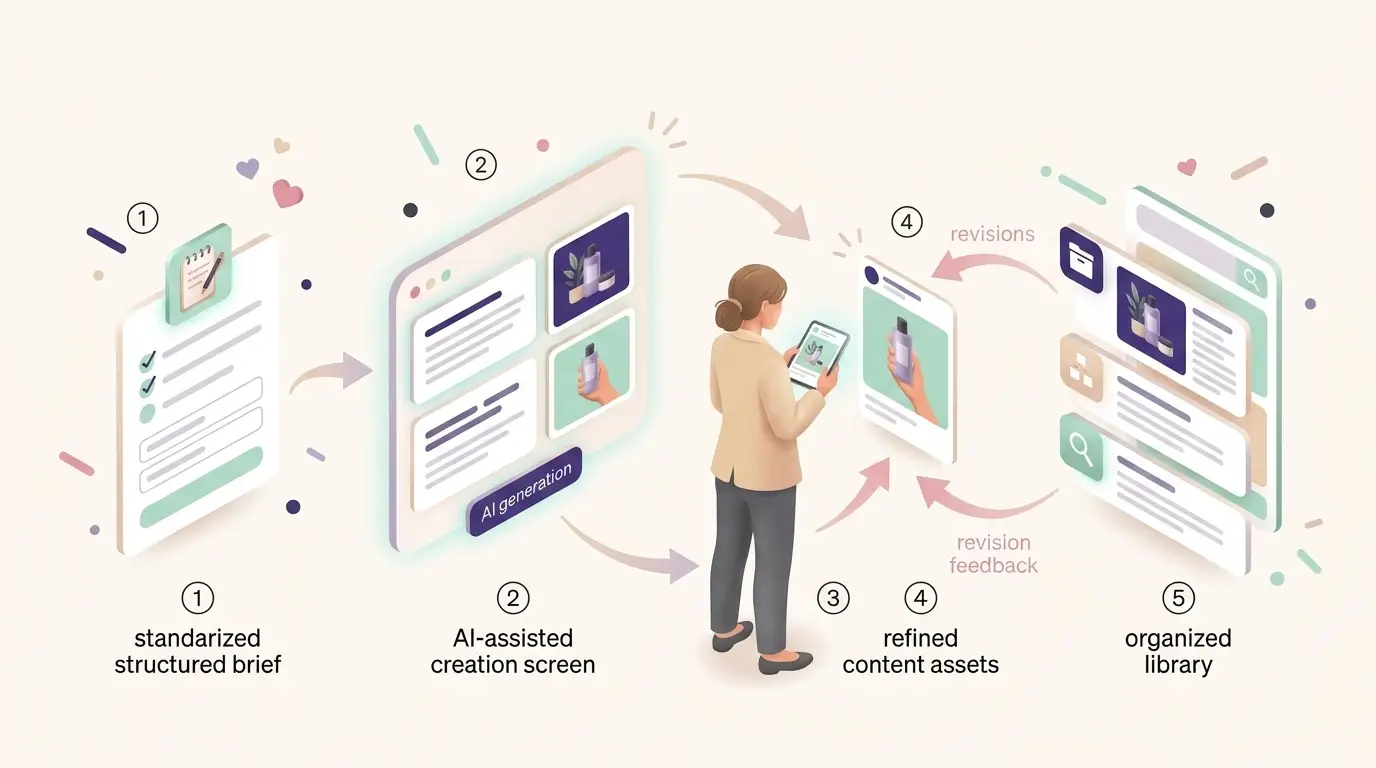
Repeatable AI content production depends less on the generation tool and more on standardizing planning, research, outlining, drafting, fact-checking, editing, publishing and iteration. Let AI expand options while humans retain responsibility for facts, judgment and brand expression.
- 01
Standardize the workflow from planning through post-publish improvement
- 02
Never treat generated output as publication-ready without human checks
- 03
Save strong structures, prompts and assets as reusable production knowledge
What to standardize first in AI content production
For articles, social, ads or video, define who the content is for, what it needs to communicate and what action should follow.
Collect internal materials, product facts, primary sources and trustworthy external information before drafting. Do not rely on generation alone for factual research.
Before choosing generation tools, standardize the brief: objective, audience, channel, references, constraints and definition of done. Inconsistent inputs produce inconsistent outputs regardless of prompt sophistication.
Designing generation, review and fact-checking
Give each section a clear job and remove overlapping points. Section-by-section generation is easier to review than producing an entire long-form piece in one pass.
Check facts, numbers, names, logic, tone, restricted claims, rights and CTA. Treat plausible-sounding errors as a normal risk that the process must catch.
Human review should follow a fixed checklist for facts, brand language, rights, channel requirements and CTA rather than subjective polishing. Time-sensitive information must be verified against current sources before publication.
Reuse, quality control and continuous improvement
Check title, metadata, links, image rights, terminology, mobile presentation and analytics so quality does not depend on one operator's memory.
Save structures, prompts, image directions and failure examples that worked or failed, then feed them back into the next brief.
Save not only the final asset but also the input conditions, structure and revision reasons that made it work. Future production can start from proven patterns and change only what needs to change, improving both speed and consistency.
Related specialist guides
Go deeper on the parts of this topic that matter to you